

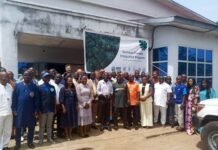


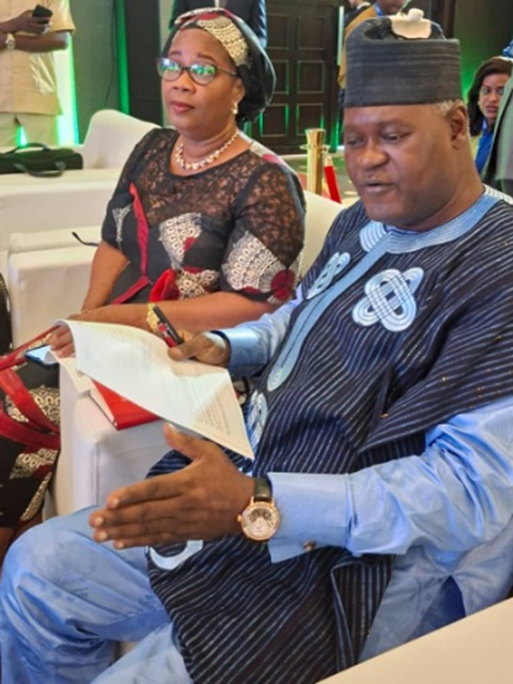
Joseph Fitzgerald Kamara, widely known as JFK, has emerged as a compelling continental voice on health equity and governance following his high-profile participation at the African Leaders Conference on Health held on 9 December 2025 in Accra, Ghana. Attending the conference alongside his wife, the All People’s Congress (APC) presidential flagbearer aspirant positioned himself not merely as a national political figure, but as a statesman advancing ideas with far-reaching implications for Africa’s future.
Speaking to Ghana’s National Public Radio on the conference theme, “Decolonising Africa’s Health Architecture,” Kamara argued that Africa’s health crisis must be understood beyond the narrow lens of infrastructure deficits and donor investment. He framed health as the foundation of human dignity, national security, and economic productivity, stressing that weak health systems undermine the very fabric of statehood. According to him, Africa’s challenges stem not only from scarcity, but from fragmented systems and inherited colonial models that privilege curative care in urban centres at the expense of resilient, community-based primary healthcare.
Drawing from his distinguished background in law, governance, and anti-corruption advocacy, Kamara advanced a firm case for accountable health financing and radical localisation. He warned that corruption within the health sector carries a uniquely devastating cost, noting that every dollar diverted represents stolen care from mothers, children, and the future workforce. His intervention resonated strongly with delegates, who viewed his argument as both morally grounded and strategically sound.
Kamara further championed the urgent need for regional pharmaceutical manufacturing, asserting that Africa’s health sovereignty will be secured not only in hospitals, but in factories and laboratories. He called for a continent-wide pact to harmonise regulations, pool procurement, and incentivise local production of vaccines, diagnostics, and essential medicines. While aligned with the African Union’s Agenda 2063, his advocacy injected a renewed sense of urgency, urging leaders to translate policy aspirations into concrete industrial action.
His vision extended to the integration of technology and community health workers as a practical pathway for leapfrogging long-standing structural challenges. By elevating frontline health workers as the true backbone of the system and equipping them with digital tools and continuous training, Kamara outlined a people-centred development model that places communities, rather than institutions alone, at the heart of health delivery.
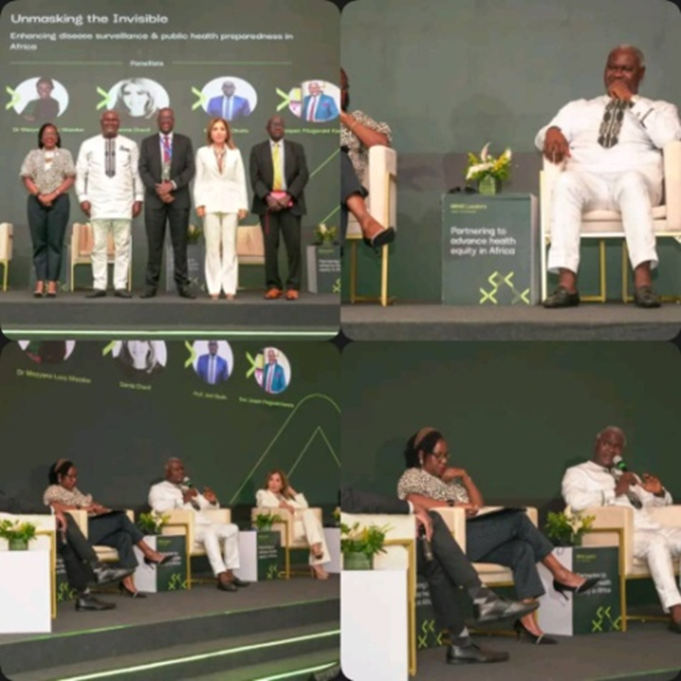
Kamara’s influence was further underscored by his role as a distinguished panelist at a high-level session titled “Unmasking the Invisible: Enhancing Disease Surveillance and Public Health Preparedness in Africa.” The panel brought together policymakers, experts, and global health partners to explore strategies for strengthening early-warning systems, improving data-driven decision-making, and building community-centred surveillance structures capable of detecting emerging threats before they escalate into full-blown crises. His contribution highlighted the critical link between health security and regional stability, reinforcing Sierra Leone’s place within Africa’s collective public health agenda.
In the corridors of the Kempinski Hotel, where much of the conference’s informal diplomacy unfolded, Kamara was widely regarded as a different kind of political leader; one who approaches public health not as a campaign slogan, but as a question of justice and intelligent statecraft. For many delegates, his presence affirmed that effective leadership in 21st-century Africa demands a deep understanding that the health of a nation is, ultimately, the wealth of a nation.
Joseph Fitzgerald Kamara’s growing continental profile comes at a pivotal moment in his political journey at home. A former Attorney General and Minister of Justice of Sierra Leone, Kamara is respected for his firm stance on the rule of law, anti-corruption reforms, and institutional accountability. His career has been defined by public service, legal scholarship, and a reputation for discipline and principle within the APC. As he vies for the party’s presidential flagbearer position, his engagement in Accra reinforces his image as a leader with both national credibility and international reach.
As the African Leaders Conference on Health draws to a close, Kamara’s participation has left a lasting impression. He departs Accra not only as a Sierra Leonean political aspirant, but as a persuasive continental thinker on one of Africa’s most urgent challenges: safeguarding the health of its people, its most precious resource.